




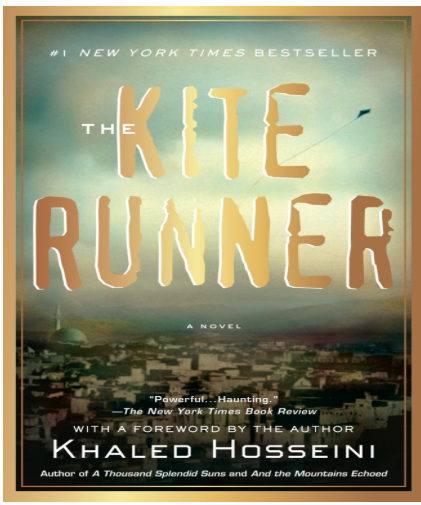
















“There is a way to be good again” is the line that sets up the premise of Khaled Hosseini’s bestselling novel, The Kite Runner (2003). Centered on sins and atonement, Hosseini’s work stands out not only for its emotional and thoughtful design but also for how it blends personal guilt with Afghanistan’s turbulent history. While his later works, A Thousand Splendid Suns (2007) and And the Mountains Echoed (2013), expand into broader and more compelling storytelling, The Kite Runner remains his most intimate and morally focused narrative: how one boy’s betrayal sets the story in motion.
Born on March 4, 1965, in Kabul, Afghanistan, Khaled Hosseini was the son of a diplomatic father and a mother who worked as a teacher. During his childhood, Hosseini and his family moved to Paris because of his father’s job. However, the Soviet invasion of Afghanistan in 1979 made it impossible for the family to return home, and so they settled in the United States. There, Hosseini grew up in San Jose, where he attended school and later studied medicine. He eventually became a doctor before beginning his career as a writer. Many of his experiences as an Afghan immigrant inspired his writing and shaped many of his novels’ central themes. In 2003, Hosseini published The Kite Runner, which quickly became an international bestseller. The book brought worldwide attention to Afghan culture and history. He is also involved in humanitarian work and supports refugees through his charity work.
The Kite Runner is connected to the literary movement known as contemporary literature, a movement that focuses on personal identity, family relationships, cultural conflicts, and social issues, which are all covered in the novel. The work’s genre can also be seen as both realistic and historical fiction. The novel is realistic due to its wide range of characters, emotions, and conflicts that feel believable and reflect real human experiences. It is equally a historical fiction due to the plot structured around real historical events that took place in Afghanistan, including the fall of the monarchy, the Soviet invasion, the Taliban rule, and the refugee crisis. These historical events are what strongly influence the characters in the novel.
Set in 1975 Kabul, the story takes place in this eastern urban center of Afghanistan, which was then known for its economic and political stability. It stood at a time of relative peace where men, women, and children had access to education, busy markets, and kite-fighting tournaments. Although the city was progressively transitioning into modernization, strong social divisions still remained among ethnic groups — the Pashtun majority and the Hazara minority — setting the dynamics of Amir and Hassan. In the winter of 1979, Soviet troops invaded the country, killing thousands of Afghans and displacing many. By 1989, the troops withdrew, yet a new conflict emerged between different Mujahideen groups, each fighting for territorial control. In the mid-1990s, the Taliban rose to power, marking the end of the heartfelt tradition of kite running and the beginning of cultural oppression.
Amir is the narrator and main character of the story. At the beginning of the novel, he is insecure and desperate for his father’s love and approval. Even though Amir cares for Hassan as a friend, a serious situation arises between the two, drawing tension because of Amir’s guilt. This shapes Amir’s development from a selfish and fearful child to a brave adult willing to make up for his mistakes. Hassan serves as Amir’s loyal friend and servant, who cares for him dearly. He is a character who does not change much throughout the story, as he already represents innocence and goodness. While Baba has a connection to both boys, he is also a respected man throughout his community. Amir, being his son, shows the high expectations of what a man should be, thus being pushed upon him by his father. Later in the story, we learn that Baba is not as perfect as one may think, with many secrets and mistakes coming to light. Though taking a small part in the story’s plot, Rahim Khan is a mentor to Amir and is friends with his father, Baba. He supports Amir as a child and later encourages his redemption. Along with Soraya, who is Amir’s wife, she provides him a safe place for his emotions and understanding. This also comes from her own struggles with her past, helping Amir realize that everyone has a past in one way or another. Through Soraya, Amir learns honesty and acceptance.
However, the relationships Amir builds throughout his life do not hide the economic and hierarchical differences he had been exposed to as a child. The house he lived in for the majority of his childhood is described as the “most beautiful house in the Wazir Akbar Khan district”, featuring marble floors and mosaic tiles which contrast sharply with his servants’ “mud hut by the loquat tree”. Nurtured in different environments, this setting attributes different qualities to our characters: Hassan for his humility and righteousness, for he is born of a humble background, and Amir for his entitlement and conceit, where his needs rarely lacked in his childhood. The streets of Kabul, the winding alleys and bustling bazaars, are common places where the boys spent exploring and running kites. They reflect on the experience of childhood innocence that few readers may relate to, and the realization that ordinary moments can hold both joy and unspoken conflicts — Amir’s complicated relationship with Hassan, where a single moment during the winter kite-fighting tournament becomes the turning point in Amir’s life. Well, after the war forces him to emigrate to the United States, a phone call from an old family friend, Rahim Khan, offers him a chance at redemption. Now back to a changed Afghanistan, he must overcome both the country’s transformation and the truth he spent years avoiding.
Taking from Amir’s journey to bravery, Hosseini reveals an important lesson: how guilt pushes one towards reform. For instance, the symbolic phrase, “There is a way to be good again,” becomes the novel’s promise of redemption, telling Amir that forgiveness is redeemable only through consciously owning up to our mistakes and acting upon them. Another theme addressed in the narrative is the social divide between the Pashtuns and the Hazara. Throughout the novel, Amir’s and Hassan’s brotherhood is constantly strained by the boundaries of societal division, and the hatred that consumed Afghanistan against minority groups. This prejudice not only affects Afghan society but also its cultural and familial upbringings. Lastly, the loss of innocence and its transition to guilt as shown when Amir reflects, “I ran because I was a coward”. In the novel, Amir’s recollections of kite-running remain; however his safety gradually fades as political conflicts escalate. Additionally, what was seen as an act of cowardice in his youth should instead be viewed in a different viewpoint as an act of survival instinct and self-preservation. While perhaps not ideal, the transformation of Afghanistan mirrors Amir’s internal shift, exemplifying how war reiterates not only the landscape but also the identities of those within it. Central to this thematic shift the use of symbolism such as the kite, represented from beginning to the end. The kite represents friendship and approval. Later in the novel the kite became a symbol for redemption and hope. Additionally, the foreshadowing of the story prepares readers for important events and builds tension throughout the story. An example of this is how Baba appears to be a man of honor but throughout the story this honor is brought to the truth of Baba’s past.